The Temple Premises

The Temple Premises

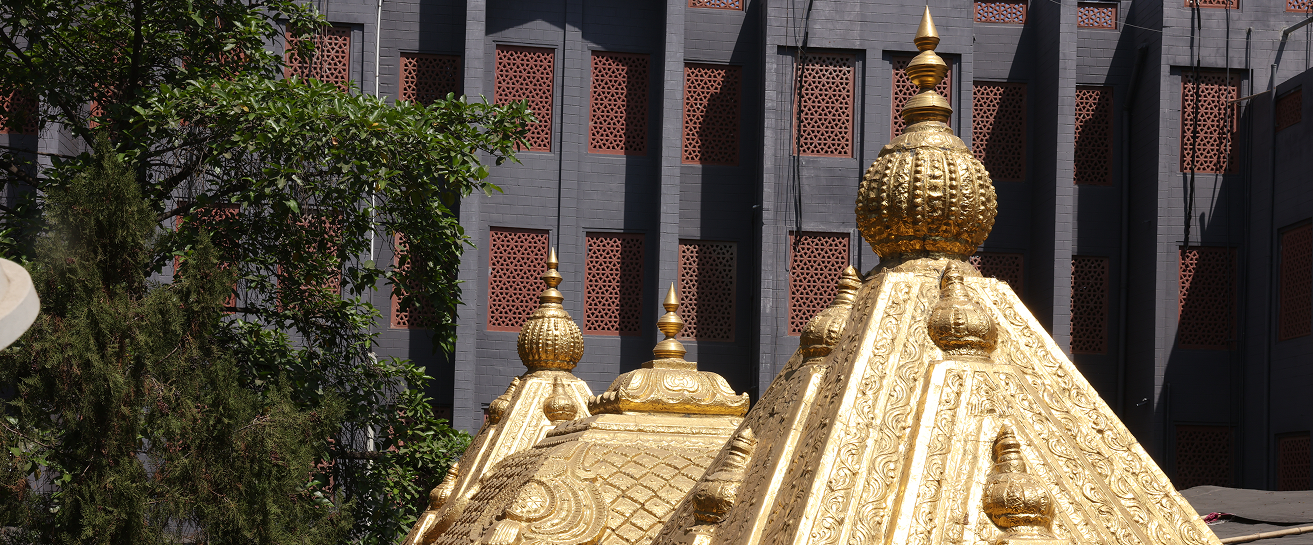
The sacred seat of the Guru — where Baba first appeared beneath the ancient neem tree

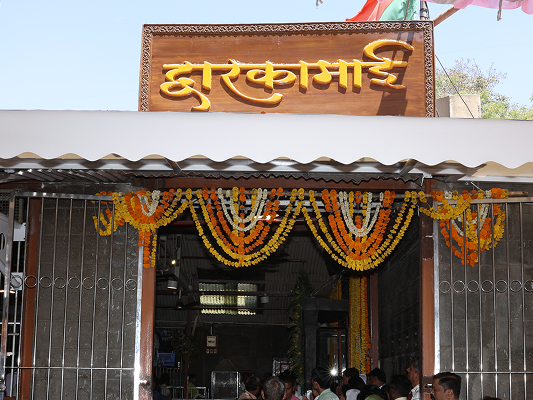
About Dwarkamai

A simple mosque transformed into the most sacred ground in Shirdi

Dwarkamai is an old mosque situated in the heart of Shirdi — simple in structure, without grandeur or ornament — yet it is among the most sacred places in all of India, simply because Shri Sai Baba chose to live here for the greater part of his life. For more than sixty years, Baba made this modest mosque his home, his court, his hospital, his temple, and his school.

The structure itself is unremarkable: a low-ceilinged space with thick walls, a flagstone floor, and the smell of incense, wood smoke, and flowers that has accumulated over generations. Its spiritual character derives entirely from the presence and actions of Baba — the fact that he sat here, cooked here, healed the sick here, settled disputes here, and welcomed all who came, regardless of religion, caste, or social standing.

Baba himself referred to the mosque as "my mother Dwarkamai." He taught that she would look after all her children — that anyone who entered with sincerity and faith would receive her protection. By calling the mosque his mother, Baba transformed it from a place of worship for a single tradition into a universal mother's home, open to all without distinction.

Devotees who enter Dwarkamai today describe an atmosphere that is simultaneously simple and overwhelming — the plainness of the physical space combined with the intensity of the devotional energy accumulated there over more than a century creates an experience unlike that of any conventional shrine.
About Dwarkamai

History and Renovation of the Masjid

How devotees gradually restored the mosque with Baba's blessing

When Baba first came to reside in the mosque, it was in a state of some dilapidation — crumbling in places, without proper facilities, exposed to the elements in parts. Some of Baba's devoted followers felt that the place where Baba lived should be made more comfortable and dignified, and various attempts were made over the years to carry out improvements.

Baba, however, was remarkably indifferent to comfort and to the condition of the physical structure. He lived without furniture, slept on the floor or on a wooden plank, cooked on an open hearth, and moved freely between Dwarkamai and Chavadi without concern for physical ease.

Yet, over time, Baba allowed his devotees to make certain improvements. Key figures in the gradual renovation included Nana Chandorkar, Nana Nimonkar, Mahalsapati, and Tatya Kote Patil — all deeply devoted and trusted by Baba. Their contributions were made with Baba's knowledge and tacit approval, and each addition brought new dignity to the sacred space without disturbing its essential simplicity.

The renovation was never comprehensive or systematic but was done piecemeal, as devotion and resources allowed. What emerged was a sacred space that retained the authentic character of Baba's simple life while providing the infrastructure for the increasing numbers of pilgrims who came to seek his darshan and blessings.

Baba's Fondness for Lamps

The miracle of lamps that burned with water

Shri Sai Baba had a deep love of lamps. He would keep oil lamps burning throughout the night in Dwarkamai, both as a devotional practice and as a practical light source. He would go daily to the shops of the oil merchants in Shirdi to collect oil for his lamps, and the shopkeepers would generously contribute.

One day, for reasons of their own, the oil merchants colluded and decided to refuse Baba's request for oil. Baba said nothing, returned to Dwarkamai, and poured water from his tin into the lamps. The lamps — lit with water instead of oil — burned brightly throughout the night, as though filled with the finest oil.

The next morning, when the shopkeepers heard what had happened, they were overcome with shame and remorse. They went to Baba, fell at his feet, and begged his forgiveness. Baba forgave them readily, as was his nature, and the episode became one of the most famous of the many miraculous events associated with Dwarkamai.

The incident speaks not only to Baba's miraculous power but to his characteristic simplicity. He did not scold the merchants, demand their repentance, or make a display of his power. He simply did what was needed to keep the lamps of devotion burning.

Baba's Fondness for Lamps

Association with Dwarka

The name "Dwarkamai" was given to the mosque by Baba himself. It is a combination of two words: "Dwaraka" — the legendary city of Lord Krishna, one of the four sacred dhamas of Hinduism — and "Mai" — meaning mother. By naming the mosque thus, Baba sanctified the Islamic structure with a name that honored the Hindu sacred city of Krishna, expressing in a single word his characteristic merging of traditions.

The deeper significance of the name is that Baba himself was regarded by many of his devotees as an avatar — a divine descent — and the naming of his home after Dwaraka acknowledged his divine status while simultaneously making the mosque accessible to people of all faiths as a universal mother's home.

Yadnya: The Dhuni

The perpetual sacred fire — burning uninterrupted for over a century

Yadnya: The Dhuni

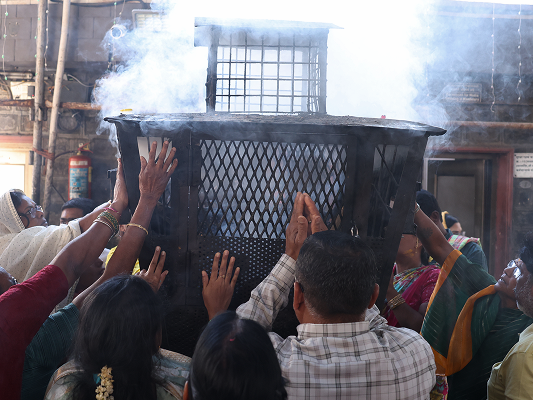
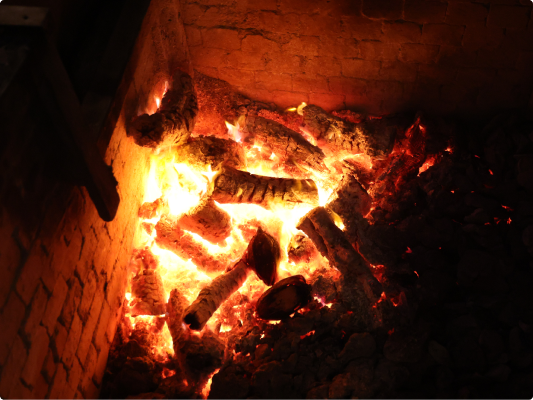
The Dhuni — a sacred fire — is one of the most powerful presences within Dwarkamai. From the moment Baba established himself in the mosque, he maintained a perpetual fire burning in an earthen hearth, and this fire has continued to burn without interruption from that time to this day. It is one of the longest continuously maintained sacred fires in the Indian spiritual tradition.

The Dhuni was central to Baba's daily life and spiritual practice. He would sit near the Dhuni for long periods, throwing pieces of firewood into it as an act of devotion and spiritual offering. He was known to chant while tending the fire, and the Dhuni became the focal point around which much of the spiritual life of Dwarkamai revolved.

Baba used the Dhuni as a medium of purification. He taught that just as wood is consumed by fire to produce light and warmth, so too are the devotee's sins, attachments, and karmas consumed by the fire of knowledge and surrender. The Dhuni thus became a living symbol of the spiritual purification that Baba offered to all who came to him.

Baba also used the Dhuni in specific acts of grace — throwing various substances into the fire on behalf of devotees in distress, sometimes to cure illness, avert calamity, or protect someone far away. In one famous account, Baba thrust his arm into the fire to pull out a devotee's child who had fallen into a distant well at that same moment.

Udi

Sacred ash from the Dhuni — Baba's most universal blessingUdi — the sacred ash collected from the Dhuni — is perhaps the most widely distributed of all the blessings associated with Shri Sai Baba. Baba would collect the ash from the Dhuni in his hand and distribute it freely to all who came for his darshan, pressing it to their foreheads or placing it in their hands as a blessing.Countless devotees have attributed remarkable healings, transformations, and acts of grace to the application of Baba's Udi. It was and is used as a remedy for physical illness, as a protective blessing, as a spiritual balm in times of sorrow, and simply as the most tangible form of Baba's continuing presence and grace in the world.The tradition of distributing Udi continues at Shirdi today. Udi collected from the perpetually burning Dhuni at Dwarkamai is made available to devotees, who carry it with them as one of the most precious things they take away from their pilgrimage to Shirdi. The Udi is thus the Dhuni's gift to the world — the fire's blessing distributed to all who seek it.

The Meaning of Udi

Baba would say: "This Udi is my blessing. Apply it to your forehead with faith and it will protect you from all evil and disease. I am in this Udi." The ash represents the ultimate truth that all matter, all name and form, is ultimately reduced to the same substance — reminding the devotee of the transience of the physical and the permanence of the divine.

Sacred Objects and Features of Dwarkamai

Each object in Dwarkamai carries the memory of Baba's life and actions

The Kolamba and Waterpot

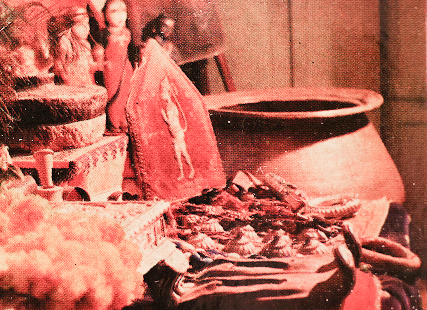
A large earthen pot (Kolamba) that Baba used for cooking. He would prepare food in large quantities and distribute it to all who came to Dwarkamai. The waterpot held water that Baba used for drinking and for various purposes during his day.

The Nimbar

A stone niche in the wall of Dwarkamai where small lamps are kept burning. The Nimbar represents the sacred space of light within the mosque — the place where oil lamps, kept alight by Baba's devotion, illuminate the interior of Dwarkamai.

The Grinding Stone

A large grinding stone that Baba used to grind wheat. During a cholera epidemic in Shirdi, Baba ground wheat himself and had the flour (atta) taken and scattered at the four boundaries of the village as a protection against the disease. The epidemic is said to have ended.

Baba's Portrait

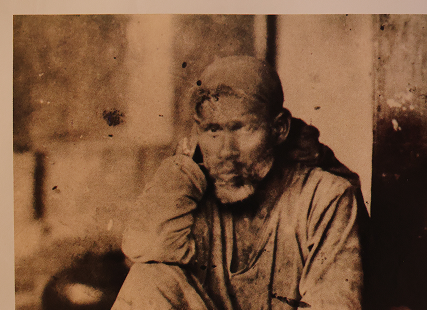
A large full-length photographic portrait of Shri Sai Baba is displayed in Dwarkamai. This portrait, taken during Baba's lifetime, is one of the most venerated images in the whole complex of Shirdi — a direct record of his physical appearance.

Dakshina Box / Hundi

The box into which devotees offer Dakshina (monetary offering). Baba accepted Dakshina and redistributed it the same day to the poor, to his devotees, and to those who needed assistance. He rarely held money overnight. The Hundi continues this tradition.

Baba's Photograph and the Stone

A photograph of Baba and a particular stone associated with him are kept at Dwarkamai. The stone served as a step or support that Baba used, and devotees venerate it as an object that Baba himself touched repeatedly.